Saturday, February 25, 2012

Should we Reinforce Effort or the Results?” By Roger Abrantes

Dog using its nose to search a target scent (photo from http://www.houndcrazy.com).

If you ask, “should we reinforce effort or the results?” you are liable to get as many answers supporting one idea as the other. Supporters of reinforcing effort sustain that reinforcing results creates emotional problems when one doesn’t succeed and decreases the rate of even trying. Supporters of reinforcing results maintain that reinforcing effort encourages sloppiness and cheating.

I shall proceed to argue for and against both theories and prove that it is not a question of either/or, rather of defining our criteria, processes and goals clearly.

I shall compare the learning of some skills in dogs and humans because the principles are the same. The difference between them and us is one “of degree, not of kind,” in the words of Darwin.

I will use SMAF to accurately describe some of the processes whenever I consider it advantageous. If you are not proficient in SMAF, you can read the free SMAF manual at http://wp.me/p1J7GF-8Y.

The main difficulty in some learning processes isreinforcing the right behavior at the right time,which bad teachers, bad parents and bad trainers do not master (here bad means inefficient, it is not a moral judgment).

Much of my personal work with dogs (and rats) is and has been detection work, mainly of narcotics and explosives, but also of people tobacco and other items. One of the first signals I teach the animals is a disguised reinforcer.

With dogs, I use the sound ‘Yes’ (the English word) and with rats a ‘bip….bip….bip’ sound produced on their backpacks and triggered by me.The signal part of this signal/reinforcer means “continue what you’re doing” and the reinforcer part “we’re OK, mate, doing well, keep up.” This is a signal that becomes a reinforcer: Continue,sound(yes) that becomes a “!+sound”(yes).

The difference between the most used “!±sound”(good-job) and “!+sound”(yes) is that the former is associated and maintained with “!-treat”(small food treat) and “!-body(friendly body language) and the latter with a behavior that will eventually produce “!-treat”. The searching behavior does not produce a treat, but continuing searching does, eventually (find or no find). This is why “!+sound”(yes) is a disguised Continue,sound(yes) or the other way around.

Why do I need this interbreeding between a signal and a reinforcer?

Because the signal ‘Search’ (Search,sound) does not mean ‘Find the thing.’ Sometimes (most of the time) there’s nothing to find, which is a relief for all of us (airports and the likes are not that full of drugs and explosives).

So, what does Search,sound mean? What am I reinforcing? The effort?

No, I’m not. We have to be careful because if we focus on reinforcing the effort, we may end up reinforcing the behavior of the animal just strolling around, or any other accidental and/or coincidental behavior.

I am still reinforcing the result. ‘Search’ means, “Go and find out whether there is a thing out there.” ‘Thing’ is everything that I have taught the dog to search and locate for me, e.g. cocaine, hash, TNT, C4.

“Go and find out whether there is a thing out there” leaves us with two options that are equally successful: ‘here’ and ‘clear.’ When there is a thing present, the dog answers ‘here’ by sitting as close to it as possible (I have taught it that behavior). When there is no thing, I want the animal to tell me exactly that: the dog answers ‘clear’ by coming back to me (again because I have taught it to do that). We have two signals and two behaviors:

Thing,scent => dog sits (‘here’ behavior).

∅Thing,scent => dog comes back to me (‘clear’ behavior).

The signals are part of the environment, they are not given by me, which does not matter: a signal (SD) is a signal*. An SD is a stimulus associated with a particular behavior and a particular consequence or class of consequences. When we have two of them, we expect two different behaviors and when there is none, we expect no behavior. What fools us here is that in detection work we always have one and only one SD, either a scent or the absence of one. It is not possible to have none. Either we have a scent or we don’t, which means that either we have Thing,scent or we have ∅Thing,scent, each requiring two different behaviors as per usual. The SD is the absence of the other.

Traditionally, we don’t reinforce a search that doesn’t produce a find. To avoid extinguishing the behavior, we use ‘controlled finds’ (a drug or an explosive, we know it is there because we have placed it there to give the animal a possibility to obtain a reinforcer).

This solution is correct, except that it teaches the dog that the criterion for success is ‘to find’ and not ‘not to find,’ which is not true. ‘Not to find’ (because there is no thing out there) is as good as ‘to find.’ The tricky part is, therefore, to reinforce the ‘clear’ and how to do it to avoid sloppiness (strolling around) and cheating.

Let us analyze the problem systematically.

The following process does not give us any problems:

{Search,sound ⇒ b1(dog searches) => “!+sound”(yes) or Continue,sound(yes) ⇒ b1(dog searches) ⇒ dog finds thing (Thing,scent) ⇒ b2(dog sits=’here’ behavior) => “!+sound” + “!-treat”};

No problem, but what about when there is no thing (∅Thing,scent)? If I don’t reinforce the searching behavior, I might extinguish it. Then, I reinforce the searching with “!+sound”(yes):

{“Search,sound” ⇒ b1(dog searches) => “!+sound”(yes) ⇒ b1(dog searches) => ∅Thing,scent ⇒ b3(dog comes back to me=’clear’ behavior) => “!+sound” + “!-treat”};

It all looks good, but it poses us some compelling questions:

How do I know the dog is searching versus strolling around (sloppiness)?

How do I know I am reinforcing the searching behavior?

If I reinforce the dog coming back to me, then next time I risk the dog having a quick sniff round and coming straight back to me. That’s the problem. I want the dog to come back to me only when it finds nothing (as in it didn’t find anything).

Problems:

Reinforcing the searching behavior.

Identifying the searching behavior versus strolling around (sloppiness). How can I make sure that the dog always searches and never just strolls around?

Solution:

Reinforcing the searching behavior with “!+sound”(yes) works. OK.

Remaining problem:

I have to reinforce the ‘clear’ behavior (coming back to me), but how can I ensure the dog always searches and never just strolls around (avoid sloppiness)?

How can I make sure the dog has no interest in being sloppy or cheating me?

Solution:

To teach the dog that reinforcers are only available if and only if:

1. the dog finds the thing. {Thing,scent ⇒ b2(dog sits) => “!+sound” + “!-treat”};

2. the dog does not ever miss a thing. {∅Thing,scent ⇒ b3(dog comes back to me) => “!+sound” + “!-treat”};

Training:

I gradually teach the dog to find things until I reach a predetermined low concentration of scent (my goal). In this phase of training, there is always one thing to find. After 10 consecutive successful finds (my criterion and quality control measure), all producing reinforcers for both the searching (“!+sound”(yes)) and the finding (“!+sound” + “!-treat”), I set up a situation with no thing present (∅Thing,scent). The dog searches and doesn’t find anything. I reinforce the searching and the finding (no-thing) as previously. Next set-up: I make sure there is a thing to find and I reinforce both searching and finding.

I never reinforce not-finding a thing that is there, nor finding a thing that is not there.

Consequence: the only undesirable situations for a dog is

(1) not-finding a thing that is there (the dog did not indicate Thing,scent), or (2) indicating a thing that is not there (the dog indicates ∅Thing,scent).

(1) {Thing,scent ⇒ b3(dog comes back to me=‘clear’ behavior) => [?+sound] + [?-treat]};

Or:

(2) {∅Thing,scent ⇒ b2(dog sits=‘here’ behavior) => [?+sound] + [?-treat]};

This is (negatively) punishing negligence, but since it proves to increase the intensity of the searching, we cannot qualify it as a punisher. Therefore, we call it a non-reinforcer: “∅+sound”, “∅-treat”.

In the first case: Thing,scent => Dog comes back to me => [?+sound] + [?-treat].

Becomes:

Thing,scent => Dog comes back to me => “∅+sound”, “∅-treat”.

Then:

{Thing,scent ⇒ b3(dog comes back to me) => “∅+sound”, “∅-treat” ⇒ b1(dog searches–more intensively) => Thing,scent ⇒ b2(dog sits=‘here’ behavior) => “!+sound” + “!-treat”};

In the second case, I have to be absolutely sure that there is indeed no thing. The training area must be free from any scent remotely similar to the scent we are training (Thing,scent). This is an imperative, especially in the first phases of the training process, and the trainer that misses this point is committing major negligence.

Nevertheless, should the dog, show ‘here’ for ∅Thing,scent, then we can use the same procedure as above:

{∅Thing,scent ⇒ b2(dog shows ‘here’ behavior) => “∅+sound”, “∅-treat” ⇒ b1(dog searches–more intensively) => ∅Thing,scent ⇒ b3(dog comes back to me=‘clear’ behavior) => “!+sound” + “!-treat”}.

What if later the dog doesn’t find a thing that is there in a lower concentration than the one I used for training, or is masked by other scents?

That’s no problem, it’s not the dog’s fault. I didn’t train for it. The dog doesn’t know that it is making a mistake by giving me a wrong ‘clear.’ As far as the dog is concerned, the room is clear: {∅Thing,scent ⇒ b3(dog comes back to me => “!+sound” + “!-treat”}; The dog was not strolling around and is not cheating me.

A human example:

I reinforce the child trying to solve a math problem. ‘Well done, but you got it wrong because…” The solution is wrong, but the method was correct. Therefore, it is all a question of training. The ‘wrong’ will be eliminated with more or better training, or maybe it was caused an excessive increase in the difficulty curve of the problem (the teacher’s problem). We are not reinforcing trying; we are reinforcing the correct use of a method.

Why reinforce the process?

We must reinforce the process because of itsemotional consequences. The dog and the child must accept the challenge, must want to be challenged, and be able to give their best in solving the problem. The exercise in itself will eventually end up being self-reinforcing.

Are we reinforcing the effort rather than the success?

No, we are not. Reinforcing the effort rather than the result can even lead to false positives. The animal indicates something that it is not there because it associates the reinforcer with the behavior, not the thing. Children give us three-four quick, consecutive, wrong answers if we reinforce the trying, not the process (thinking before answering).

We reinforce result (success) only.

When the dog doesn’t find because there’s nothing to find, that is success. When the dog doesn’t find because the concentration was too low, that is also success because ‘too low’ is here equal to ‘no thing.’ When the child gets it wrong, it is because the exercise exceeded the capacity of the child (he or she has not been taught to that level).

We are still reinforcing success and exactly what we trained the dog and the child to do. We don’t say to the child, “Well, you tried hard enough, good.”

We say, ” Well done, you did everything correctly, you just didn’t get it right because you didn’t know that x=2y-z and there was no way of you knowing.”

Next time, the child gets it right because she now knows it; and if not, it is because x=2y-z exceeds the capacity of that particular child in which case there’s nothing you can do about it.

The same goes for the dog: the dog doesn’t indicate 0.01g of cocaine because I trained it to indicate as low as 0.1g. When I reinforce the dog’s ‘clear,’ I say, “Well done, you did everything correctly, you just didn’t get it right because you didn’t know that 0.01g cocaine is still the thing.”

Now, I train the dog that ‘thing’ means ‘as low as 0.01g cocaine’ and either the dog can do it or it cannot. If it can, good; if it cannot, there’s nothing you or I, the dog or the child can do about it.

Conclusion:

We reinforce result, success, not the effort, not the trying. We must identify success, have clear criteria for success, plan a successive approach to our goal and gradually increase difficulty. We must be able to recognize limits and limitations in ourselves, in the species we work with, in the individuals we tutor, in the particular skill we teach. We must know when we cannot improve a skill any further and when an individual cannot give us more than what we are getting; and be satisfied with that.

Have a great day!

R-

Footnote: * Strictly speaking, the scent that the detection dog searches is not a signal, but a cue, because it is not intentional. In this context, however, it is and SD because we have conditioned it to be so and, therefore, we can call it a signal. Please, see “Signal and Cue—What is the Difference?” at http://wp.me/1J7GF.

Friday, February 24, 2012

Dogs in court...

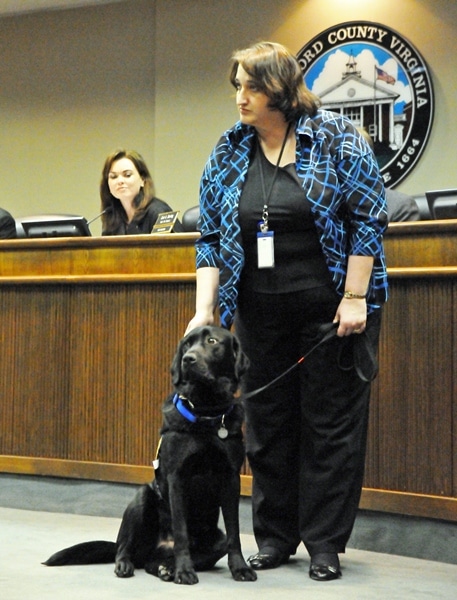
Stafford County Courthouse’s new dog, Kahn was introduced by his handler, Juanita Maley, to the county’s Board of Supervisors on Feb. 21. The dog will work with children and adult victims of sexual assault, domestic violence, elder abuse and other violent crimes. (Mary Davidson/PotomacLocal.com)

Victims of crimes in Stafford County will soon receive emotional support and comfort from a four-legged addition to the Commonwealth’s Attorney’s Victim-Witness Office. Kahn, a male black Labrador retriever, will join the Victim-Witness staff on Tuesday, February 21. The dog will work with children and adult victims of sexual assault, domestic violence, elder abuse and other violent crimes.

“Stafford’s court system has a deep respect and appreciation for the courage of the victims who come forward to work with our prosecutors,” said Chairman of the Board of Supervisors Susan Stimpson, Falmouth District. “Kahn will be a great help in making victims, especially children, more comfortable.”

Kahn will sit with victims and offer them comfort while they are being interviewed about what happened to them. Most victims, especially children, come into the office already traumatized. Having a dog there to pet relaxes people and helps them open up and give details to help bolster their case. The dog will not go into the courtroom but will be available for all aspects of pretrial preparation with victims.

“The goal of having a courthouse dog is two-fold,” said Commonwealth’s Attorney Eric Olsen, “We want the dog’s presence to make children and adults more comfortable so they can better tell their story. Plus, we hope it will help make a tough experience a little easier on those who’ve already had a hard time.”

After he was formally introduced to the Stafford County Board of Supervisors, Kahn (center dog) showed his playful side. Kahn and his handler, Juanita Maley, are part of the Victim Witness Assistance Program at the Stafford County Courthouse. (Mary Davidson/PotomacLocal.com)

Kahn and his handler, Juanita Maley of the Victim-Witness Assistance Office, recently completed training with the Courthouse Dog Program. The program trains handlers to work with dogs and victims in the criminal justice system. The dogs come from a group called Canine Companions for Independence, an organization that trains canine companions, service dogs and facility dogs like Kahn.

There was no cost for the dog. The training with the Courthouse Dog Program was $5,000 and was funded by assets forfeited by convicted criminals. The dog will work daily at the Courthouse and will live with its handler

Maley, who will provide for its upkeep. Canine Companions for Independence has a network of vets who provide services at reduced costs or for free for facility dogs.

-Press release


Warning from Doctors about tick season!

BOSTON (CBS) – They’re here. The mild winter temperatures we’re enjoying mean the danger from ticks and Lyme disease has arrived early. Normally at this time of year cold weather causes ticks to go dormant, but not this winter.

We went to a park in Needham Tuesday with entomologist Dr. Richard Pollack to see how easy it is to find the ticks. He dragged a small piece of fabric along the vegetation and after a couple of passes, there were deer ticks on the cloth.

WBZ-TV’s Jonathan Elias reports

“This unseasonable weather has extended the season for these ticks,” says Dr. Pollack. It’s a misconception that the first frost kills the ticks. “Normally the deer ticks are quiet. They’re hibernating at this time of year, but if it’s warm enough to be outside, it’s warm enough for the ticks to be active,” says Pollack. And that means a risk of Lyme disease at a time when you usually don’t have to worry about it. “The take home message really is if you’re out there enjoying the weather, take precautions. You may bring them home, your pets may bring them home,” says Pollack.

We met Norma Calder enjoying the lovely weather, walking her dog. She’s been on the lookout for ticks on her pet. “This winter I’ve probably found 10 or 12,” she says.

At Angell Animal Medical Center in Boston, they’re aware of the potential problems. “Whenever we do have warmer temperatures there is an uptick in the number of ticks we’ll see on dogs,” says Angell veterinarian Dr. Kiko Bracker.

A lot of dog owners take the winter off from applying tick preventative medications, but Dr. Bracker says that’s a bad idea this time. “This year it’s really best to use the tick repellants and tick preventatives twelve months a year, just to be safe,” he says.

The good news, this unusual tick activity now doesn’t mean there will be more of them in the Spring. In fact, if it stays dry some of them could die off because ticks don’t do well in dry weather. In either case, come Spring, we can also start worrying about mosquitoes.

Thursday, February 23, 2012

Ceaser Millian... A pack of Lies.....

OP-ED CONTRIBUTOR

Pack of Lies

Published: August 31, 2006

Miami Beach

Jeffrey Decoster

WITH a compelling personal story as the illegal immigrant made good because of his uncanny ability to understand dogs, Cesar Millan has taken the world of canine behavior — or rather misbehavior — by storm. He has the top-rated program, “Dog Whisperer,” on the National Geographic Channel, a best-selling book and a devoted following, and he has been the subject of several glowing magazine articles.

He is even preparing to release his own “Illusion” collar and leash set, named for his wife and designed to better allow people to walk their dogs the “Cesar way” — at close heel, under strict control.

Essentially, National Geographic and Cesar Millan have cleverly repackaged and promoted a simplistic view of the dog’s social structure and constructed around it a one-size-fits-all, cookie-cutter approach to dog training. In Mr. Millan’s world, dog behavioral problems result from a failure of the human to be the “pack leader,” to dominate the dog (a wolf by any other name) completely.

While Mr. Millan rejects hitting and yelling at dogs during training, his confrontational methods include physical and psychological intimidation, like finger jabs, choke collars, extended sessions on a treadmill and what is called flooding, or overwhelming the animal with the thing it fears. Compared with some training devices still in use — whips and cattle prods, for example — these are mild, but combined with a lack of positive reinforcement or rewards, they place Mr. Millan firmly in a long tradition of punitive dog trainers.

Mr. Millan brings his pastiche of animal behaviorism and pop psychology into millions of homes a week. He’s a charming, one-man wrecking ball directed at 40 years of progress in understanding and shaping dog behavior and in developing nonpunitive, reward-based training programs, which have led to seeing each dog as an individual, to understand what motivates it, what frightens it and what its talents and limitations are. Building on strengths and working around and through weaknesses, these trainers and specialists in animal behavior often work wonders with their dogs, but it takes time.

Mr. Millan supposedly delivers fast results. His mantra is “exercise, discipline, affection,” where discipline means “rules, boundaries, limitations.” Rewards are absent and praise scarce, presumably because they will upset the state of calm submission Mr. Millan wants in his dogs. Corrections abound as animals are forced to submit or face their fear, even if doing so panics them.

Mr. Millan builds his philosophy from a simplistic conception of the dog’s “natural” pack, controlled by a dominant alpha animal (usually male). In his scheme, that leader is the human, which leads to the conclusion that all behavior problems in dogs derive from the failure of the owner or owners to dominate. (Conveniently, by this logic, if Mr. Millan’s intervention doesn’t produce lasting results, it is the owner’s fault.)

Women are the worst offenders in his world. In one of the outtakes included in the four-DVD set of the first season of “Dog Whisperer,” Mr. Millan explains that a woman is “the only species that is wired different from the rest.” And a “woman always applies affection before discipline,” he says. “Man applies discipline then affection, so we’re more psychological than emotional. All animals follow dominant leaders; they don’t follow lovable leaders.”

Mr. Millan’s sexism is laughable; his ethology is outdated.

The notion of the “alpha pack leader” dominating all other pack members is derived from studies of captive packs of unrelated wolves and thus bears no relationship to the social structure of natural packs, according to L. David Mech, one of the world’s leading wolf experts. In the wild, the alpha wolves are merely the breeding pair, and the pack is generally comprised of their juvenile offspring and pups.

“The typical wolf pack,” Dr. Mech wrote in The Canadian Journal of Zoology in 1999, “is a family, with the adult parents guiding the activities of a group in a division-of-labor system.” In a natural wolf pack, “dominance contests with other wolves are rare, if they exist at all,” he writes.

That’s a far cry from the dominance model that Mr. Millan attributes to the innate need of dogs by way of wolves.

Unlike their wolf forebears, dogs exist in human society. They have been selectively bred for 15,000 or more years to live with people. Studies have shown that almost from birth they are attentive to people, and that most are eager to please, given proper instruction and encouragement.

But sometimes the relationship goes very wrong, and it is time to call on a professional.

Aggression is perhaps the most significant of the behavioral problems that may afflict more than 20 percent of the nation’s 65 million dogs, because it can lead to injury and death. Mr. Millan often treats aggression by forcing the dog to exercise extensively on a treadmill, by asserting his authority over the dog by rolling it on its back in the “alpha rollover,” and through other forms of intimidation, including exposure to his pack of dogs.

Forcefully rolling a big dog on its back was once recommended as a way to establish dominance, but it is now recognized as a good way to get bitten. People are advised not to try it. In fact, many animal behaviorists believe that in the long run meeting aggression with aggression breeds more aggression.

More important, aggression often has underlying medical causes that might not be readily apparent — hip dysplasia or some other hidden physical ailment that causes the dog to bite out of pain; hereditary forms of sudden rage that require a medical history and genealogy to diagnose; inadequate blood flow to the brain or a congenital brain malformation that produces aggression and can only be uncovered through a medical examination. Veterinary behaviorists, having found that many aggressive dogs suffer from low levels of serotonin, have had success in treating such dogs with fluoxetine (the drug better known as Prozac).

Properly treating aggression, phobias, anxiety and fears from the start can literally save time and money. Mr. Millan’s quick fix might make for good television and might even produce lasting results in some cases. But it flies in the face of what professional animal behaviorists — either trained and certified veterinarians or ethologists — have learned about normal and abnormal behavior in dogs.

Related Articles

Wednesday, February 22, 2012

How to use kong... A great training tool....

RECIPE FOR THE "ALMOST PERFECT" DOG
It is reassuring to know that the ingredients for an "almost perfect" dog are available to any responsible dog owner. You can enjoy the wonderful
benefits of an "almost perfect" dog. The ingredients are:

1. One clean bill of health. You can help ensure this vital ingredient with current vaccinations and regular veterinary check ups.
2. One proper I.D. Make sure your dog has a license and/or I.D. (dog tags, tattoo, canine microchip).
3. One well-nourished, well-exercised dog. Feed your dog as recommended by your veterinarian, professional trainer or breeder. Exercise your dog as often as possible.
4. One safe, secure, comfortable environment free from abuse and neglect. If your dog spends much time outdoors, a well-insulated dog house in a fenced area should be provided. Inside, a crate (dog den) is recommended by most trainers. Start crate training early - ask your veterinarian!
5. A full measure of time. Time spent with your dog should include training flavored with reward, correction/positive reinforcement, petting, grooming and exercise such as walking, playing, fetching, and just being with you and your family.

Missing ingredients result in behavior problems. Over 60% of dogs in shelters are there as a result of behavior problems or lack of identification.

MOST BEHAVIOR PROBLEMS ARE CORRECTABLE!
Don't despair! Make sure your dog has a clean bill of health, then contact your professional trainer and/or animal behaviorist for help.

Prevention is always the best cure for behavior problems! Lack of training and physical and mental understimulation (boredom) are primary causes of misbehavior. They can be easily prevented by enrolling in basic training classes (contact your veterinarian for a referral) and using Kong Dog Toys for healthy physical and mental stimulation.

Kong Dog Toys are widely used and recommended for therapy and prevention of understimulation, boredom, separation anxiety and other behavior problems. Following are some simple ways Kongs can be utilized to promote good behavior in your dog.

It is important for dogs to succeed at their "work". Make it easy to remove the kong stuffing at first. AS THEY BECOME MORE EXPERIENCED, YOU MAY WANT TO MAKE THEIR JOB MORE CHALLENGING - HERE'S HOW:

1. Pack stuffing tighter.

2. Wedge biscuits inside the cavity using the inside rim of the opening to secure them.

3. FREEZE IT! Very Popular! Try various combinations of canned food, gravy, noodles, rice and mashed potatoes mixed with food nuggets and freeze. KONGSICLES are a favorite with many hot dogs! Put a dab of peanut butter in the small end of the Kong to plug it. Turn it upside down in a cup. Fill it full of water, chicken broth or fruit juice and freeze. Cool doggies! Kongsicles are recommended for outdoor use.

4. CHEESE IT! Mix cheese pieces or cheese spread with food nuggets and microwave until cheese melts. Let it cool to a safe temperature. NOTE - Use a cup to contain the Kong when freezing or microwaving.


KONG STUFFING RECIPES
As you create recipes, be sensitive to your dog's tummy as you experiment. Following are recipes created by veterinarians, dog trainers and dog lovers worldwide.

BANANA RAMA: 1 fresh banana · 2 tbs wheat germ · 1 tbs plain yogurt (can use your pet's favorite flavor as well) · Kong Toy that best fits your pet's chewing temperament In a bowl, mash up banana. Then, add wheat germ and yogurt. Mash all ingredients together and use spoon to add to Kong. Freeze for 4 hours. Makes 1 serving for Medium Kong. Double for every Kong Size that is bigger.

CHEESY DENTAL KONG DELIGHT: 3 slices of your pet's favorite cheese · Dental Kong Toy A very simple and creative way to make any pet drool in delight. Just place the 3 slices of cheese directly onto the grooves of your pet's Dental Kong (if model has rope - make sure cheese does not get onto it). Melt in microwave for 20 to 30 seconds. Give to pet after it cools.

PHILLY STEAK: steak scraps · 1 ounce cream cheese · appropriate Kong Toy Place small scraps of the steak inside Kong toy. Spread cream cheese in large hole to hold scraps.

FRUIT SALAD: apple and carrot chunks · 1/4th of a banana · appropriate Kong Toy Place apples and carrots in Kong Toy. Mush the banana in large hole to hold fruit in place. You can include other fruits and veggies: orange slices · peach and/or nectarine chunks · celery sticks · broccoli and/or cauliflower · tomato and black olive mixture.

VEGGIE KONG OMELET: 1 egg · your choice of shredded cheese · any vegetables that your pet may like · appropriate Kong Toy Scramble egg and fold in vegetables. Put into Kong toy. Sprinkle some cheese over the top and microwave for about 20 seconds. Cool thoroughly before giving to dog.

MAC 'N CHEESE: Leftover macaroni and cheese · small cube of Velveeta · appropriate Kong Toy Melt Velveeta in microwave until gooey. Add mac 'n cheese to Kong Toy. Pour heated Velveeta into Kong. Make sure it has cooled before giving to your pet.

FAMOUS RECIPES
AUNT JEANNIE'S ARCHEOLOGY KONG (for advanced dogs) LAYER ONE (deepest): roasted, unsalted cashews · freeze dried liver bits LAYER TWO: dog kibble, cookies or liver biscotti · Cheerios · sugar-free, salt-free peanut butter · dried banana chips, apples and apricots LAYER THREE: carrot sticks · turkey or leftover ravioli or tortellini · Kong Toy (the larger the better!) Pack as tightly as possible. The last item inserted should be an apricot or piece of ravioli, presenting a smooth "finish" under the main opening. LIGHT VERSION: substitute crumbled rice cakes for cashews, Caesar croutons for freeze-dried liver, fat free cream cheese for peanut butter. - by Jean Donaldson

KONG ON A ROPE: Dry dog kibble · appropriate Kong Toy · Rope Take the rope, pull it through the Kong Toy and knot it. Hang this upside down from a tree, deck or post. The small hole should be facing the ground. Take the kibble and fill the Kong Toy. Make the toy hang just low enough that it is out of your dog's reach. The dog will spend hours trying to retrieve the kibble from the Kong Toy. At the end of the day, take the remaining kibble and give to your pet as a reward. This is advanced work for your dog. - by Ian Dunbar

FROZEN JERKY POPS: Peanut butter · bouillon · Jerky Strips · Water · appropriate Kong Toy · muffin tin Smear a small amount of peanut butter over small hole in your Kong Toy. Fill the cool water and add a pinch of bouillon. Place a Jerky Stick inside Kong Toy and freeze. This can also be put (once frozen) in a children's size swimming pool for a fun day of fishing for your pet. - by Terry Ryan

SIMPLE, TRIED AND TRUE: Peanut butter · appropriate Kong Toy Smear peanut butter inside the cavity of your Kong Toy. It's that easy! - by trainers and vets worldwide

TRIXIE'S FAVORITE: Trixie, a 50 pound Aussie/Springer mix, loves turkey, chicken or marrow bites mixed with slightly moistened food nuggets frozen inside her Kong. She is very clean about unstuffing - some dogs are not! - by Joe Markham

Every dog has a favorite recipe - finding your dog's will be fun! REMEMBER: Some foods are not healthy for dogs. Check with your vet first.

KONG HUNTING
Hide stuffed Kongs indoors and/or out. The hunt is great fun and rewarding. IMPORTANT! a. Provide stuffed Kongs randomly so they won't always be associated with you leaving. b. If your dog is unstuffing several Kongs per day, you should appropriately reduce the amount of bowl feeding. c. CLEAN KONGS THOROUGHLY AFTER USE! Dishwasher is recommended. Your dog's job will last until the Kongs are unstuffed. You can keep your dog "working" all day if you provide enough stuffed Kongs!

IMPORTANT! Use Kongs Safely! Your dog's safety is your responsibility! ALWAYS supervise your dog's use of Kongs until you are confident they can be used safely without you! Read Kong Toy User Guide!


Tuesday, February 21, 2012

Ohio law now focuses on the behavior not the breed!


Ohio’s pit bull owners are celebrating today after Governor Kasich signed HB 14, into law, marking the end of 25 years of discrimination against the breed.

“We appreciate the support of the Ohio County Dog Wardens, the County Commissioners’ Association of Ohio, the Ohio Coalition of Dog Advocates and countless other animal welfare groups, dog-loving individuals and veterinarians whose efforts resulted in the bill’s successful passage,” said Ledy VanKavage, senior legislative analyst for Utah-based Best Friends Animal Society, which has been supporting the bill.

Ohio has been the only state in the country to automatically declare a dog vicious based solely on appearance, without considering behavior. Any pit bull terrier-type dog or any dog resembling a pit bull fell under the law. HB 14 removes the breed-discriminatory designation and strengthens the state’s dangerous dog laws so that they more correctly target reckless owners and dangerous dogs instead of innocent pets.

VanKavage, nationally respected expert on pit bulls and reckless owner/dangerous dog legislation, testified twice in 2011 before the Ohio legislature encouraging the repeal of the breed discriminatory law.

A petition at Change.org garnered nearly 18,000 signatures in favor of repealing the law. Legendary singer/songwriter Willie Nelson, a spokesperson for Best Friends, sent a letter to Ohio legislators last November urging the “favorable and quick” passage of Ohio House Bill 14. Actress and activist Maggie Q also urged passage of HB 14 through a YouTube video. And actor Ian Somerhalder used Twitter to urge his fans to voice their support for the bill by sending letters and signing the petition.

Breed-discriminatory laws are expensive and have been proven ineffective in protecting the public. According to economic research firm John Dunham and Associates, it cost Ohioans more than $17 million a year to enforce the old law. In these tough economic times, laws that waste precious taxpayer dollars while failing to reduce dog bites are tragically misguided.

Ohio dog wardens will now be able to focus their efforts on dangerous dogs running at large, not targeting people’s pets who are doing nothing more than being dogs with a certain appearance.

With the bill’s passage, Ohio joins the many states with laws that allow all dogs to be evaluated and treated as individuals and permit local jurisdictions the authority to hold reckless owners accountable for the behavior of their dogs.

A Mea Culpa to Mech, an Apology to Bekoff

When it comes to understanding canine behavior, Dr. David Mech—the world's leading expert on wolves—and Dr. Mark Bekoff—the world's leading expert on coyotes and canine play—are two of my biggest heroes. So imagine my chagrin to discover that they're both irritated with me.

I wrote a piece last week titled "Deconstructing the Dominance Myth (Again...)," which was a response to a personal blog post written by Dr. Roger Abrantes, posted on another part of the internet, far, far away. The main thrust of my article wasn't that dominant behaviors don't exist, but that the terms we're using to describe them are anthropomorphic, and that saddling dogs with these labels is harmful to any dogs whose behaviors may, in fact, be the result of stress or anxiety, not dominance.

I now realize, and freely admit, that I made mistakes in my article, mistakes I wasn't aware of until Dr. Bekoff pointed them out to me here.

My first mistake was referring to the concept of dominance as a myth. That's a charged word, one that carries with it the implication that scientists who have dedicated their lives to understanding animal behavior are all operating under some kind of mass delusion. I deeply regret making that insinuation, however unintentionally. In recent years, it's become fairly common in the dog training world for some of us to talk about "the myth of dominance" in a somewhat cavalier way. What's generally meant by this is that the idea of dominating a dog, as the basis for a training system, isn't based on real science and can be harmful to the human-canine bond.

Dr. Bekoff also took me to task for the following passage:

"Dr. David Mech, the world's leading expert on wolves, says that in 13 years of studying the wolves on Isle Royale in Michigan he never saw any displays of dominance. In other packs Mech says that dominance displays are so rare as to be almost nonexistent."

I turns out that this isn't exactly true. I was basing what I said on the following passage from a 1999 paper ("Alpha Status, Dominance, and Division of Labor in Wolf Packs," Canadian Journal of Zoology.): "In natural wolf packs, the alpha male or female are merely the breeding animals, the parents of the pack, and dominance contests with other wolves are rare, if they exist at all. During my 13 summers observing the Ellesmere Island pack, I saw none." (I made another mistake by getting the geographical location of Mech's studies wrong.)

Dr. Bekoff apparently sent a copy of my post to Dr. Mech, who responded with the following: "A quick scan of the Kelley article reveals much misinformation attributed to me. This misinterpretation and total misinformation like Kelley's has plagued me for years now. I do not in any way reject the notion of dominance."

In his post, Dr. Bekoff pointed me (and other readers) to a 2010 paper written by Dr. Mech and H. Dean Cluff ("Prolonged Intensive Dominance Behavior Between Gray Wolves, Canis lupus") in which they write: "Dominance is among the most pervasive and important behaviors of wolves in a pack."

Clearly, I'm not keeping up on my research. So I was wrong to insinuate, here and in other pieces I've written on dominance, that Mech believes dominance is rare or doesn't exist at all in wild wolf packs. I apologize for my mistake and will attempt to make corrections to all the pieces I've written that contain this outdated view (there are a lot of them).

But wait. It gets worse!

My thesis about the cause of dominance and submission—as outlined briefly in my post—is that they're primarily the result of a wolf's internal tension and stress. But in the comments section of Dr. Bekoff's post, Simon Gadbois, from the Canid Behaviour Laboratory at Dalhousie University in Halifax, wrote: "My PhD thesis was on social stress in wolves... Jane Packard, that had done the stress studies with Mech in the 80's was on my committee. Here I can tell you that your interpretation is wrong because you are over-generalizing. We simply do not have enough data to jump to the conclusions that you get to."

I freely admit that I am guilty of over-generalizing. That tends to happen in a short blog post. But it's also true that I have no academic training, and perhaps as a result, I have a tendency to think in broad strokes and connect some dots that might not warrant such connections. I see patterns in the data and assume correlations, but have little or no evidence that a causal relation exists. So that's another mistake on my part. (Dr. Gadbois has kindly agreed to share his research with me, so I'll be looking it over to see where my errors in thinking have occurred in this area)

However, I don't think I'm totally alone in the idea that a wolf's (or a dog's) emotional states or stress levels may be relevant to the frequency or occurrences of dominant behavior. In fact, on a personal note, Dr. Jane Packard writes, "I tend to think of the alpha behavioral profile as an internal state or mood. Moods are subject to change as the health and environment of the individual change." (Wolves: behavior, ecology, and conservation, Edited by L. David Mech and Luigi Boitani, 2003.) To me this suggests a certain, perhaps small, similarity in thinking about the causes of dominant behavior. (Or maybe I'm still connecting dots I shouldn't.)

Finally, as I said, the two main thrusts of my reply to Dr. Abrantes was that I think the words dominance and submission come laden with a lot of baggage that can be very harmful to dogs diagnosed with dominant tendencies, etc., when in fact the dog may just be anxious or stressed. Tell a dog owner that their dog has "alpha tendencies" and there's no way out. Stress and anxiety, on the other hand, are potentially fixable. However, while such matters may concern scientists on a personal level, they're of no concern to science in general. In other words, science can't change its positions just to be helpful to dogs and their owners.

My other main point was that I think the words dominance and submission—and in particular the way Dr. Abrantes' has defined them—are anthropomorphic, and that the scientific language needs to be changed. (One of the things I love about reading Dr. Bekoff's research is that he assiduously avoids being anthropomorphic; the same goes for Dr. Mech.)

My biggest error was thinking anything I posted here could in any way influence a change in scientific language. That was not only extremely naïve on my part, it was also, perhaps, the height of arrogance.

Since I consider myself a neo-Freudian dog trainer, and since young puppies doexhibit behaviors that could be viewed as dominant and submissive, behaviors that take place before the pup's brains are fully developed (meaning they're the products of unconscious urges, not rational thought processes), these labels may not be as anthropomorphic as I thought. It all depends on one's point of view. The truth is, everyone has their own ideas about what dominance is, what it looks like, how to describe it, and what to do about it. As Jane Packard writes, "Perhaps the relative importance of dominance varies with pack composition, food availability (and thus competition), and even the eyes of the beholder."

As for the concept of submission, I'm more than willing to submit to the greater wisdom of Drs. Mech, Bekoff, and Abrantes. And I sincerely apologize for my lapses in judgment and decorum.

Leading the Way offers doggie daycare and all types of training, including private, group classes and a residential training program. Behavior assessment and modification is done using ONLY positive methods focused on shaping behavior.

We have over 25 years of professional experience, dedicated to enhancing the relationship of both ends of the leash, through knowledge, compassion, and building long term relationships with our clients, both two and four legged.