Saturday, February 25, 2012

Kyle Dyer, 9NEWS and the dog bite...

VIDEO: Kyle Dyer, 9NEWS anchor, interviews with the Denver Post

Posted Feb 23, 2012

Just over 2 weeks ago she was bitten in the face by an Argentinian Mastiff that had been rescued from the icy waters of a lake by firefighters. Just as the interview was ending, Kyle got a little too close to the muzzle of the dog and he bit her directly in the face. She had extensive plastic surgery repairing her lips, part of the right side of her nose and a portion of her chin. She is making a remarkable recovery. Video by Mahala Gaylord

READ THE STORY: Two weeks after dog bite, Denver 9News anchor Kyle Dyer feels lucky
SEE: photos from the interview


Read more: Kyle Dyer, 9NEWS anchor, interviews with the Denver Post (video) | Denver Post Photos, Video http://photos.denverpost.com/mediacenter/2012/02/kyle-dyer/30159/#ixzz1nSInFUTO
Read The Denver Post's Terms of Use of its content: http://www.denverpost.com/termsofuse

Should we Reinforce Effort or the Results?” By Roger Abrantes

Dog using its nose to search a target scent (photo from http://www.houndcrazy.com).

If you ask, “should we reinforce effort or the results?” you are liable to get as many answers supporting one idea as the other. Supporters of reinforcing effort sustain that reinforcing results creates emotional problems when one doesn’t succeed and decreases the rate of even trying. Supporters of reinforcing results maintain that reinforcing effort encourages sloppiness and cheating.

I shall proceed to argue for and against both theories and prove that it is not a question of either/or, rather of defining our criteria, processes and goals clearly.

I shall compare the learning of some skills in dogs and humans because the principles are the same. The difference between them and us is one “of degree, not of kind,” in the words of Darwin.

I will use SMAF to accurately describe some of the processes whenever I consider it advantageous. If you are not proficient in SMAF, you can read the free SMAF manual at http://wp.me/p1J7GF-8Y.

The main difficulty in some learning processes isreinforcing the right behavior at the right time,which bad teachers, bad parents and bad trainers do not master (here bad means inefficient, it is not a moral judgment).

Much of my personal work with dogs (and rats) is and has been detection work, mainly of narcotics and explosives, but also of people tobacco and other items. One of the first signals I teach the animals is a disguised reinforcer.

With dogs, I use the sound ‘Yes’ (the English word) and with rats a ‘bip….bip….bip’ sound produced on their backpacks and triggered by me.The signal part of this signal/reinforcer means “continue what you’re doing” and the reinforcer part “we’re OK, mate, doing well, keep up.” This is a signal that becomes a reinforcer: Continue,sound(yes) that becomes a “!+sound”(yes).

The difference between the most used “!±sound”(good-job) and “!+sound”(yes) is that the former is associated and maintained with “!-treat”(small food treat) and “!-body(friendly body language) and the latter with a behavior that will eventually produce “!-treat”. The searching behavior does not produce a treat, but continuing searching does, eventually (find or no find). This is why “!+sound”(yes) is a disguised Continue,sound(yes) or the other way around.

Why do I need this interbreeding between a signal and a reinforcer?

Because the signal ‘Search’ (Search,sound) does not mean ‘Find the thing.’ Sometimes (most of the time) there’s nothing to find, which is a relief for all of us (airports and the likes are not that full of drugs and explosives).

So, what does Search,sound mean? What am I reinforcing? The effort?

No, I’m not. We have to be careful because if we focus on reinforcing the effort, we may end up reinforcing the behavior of the animal just strolling around, or any other accidental and/or coincidental behavior.

I am still reinforcing the result. ‘Search’ means, “Go and find out whether there is a thing out there.” ‘Thing’ is everything that I have taught the dog to search and locate for me, e.g. cocaine, hash, TNT, C4.

“Go and find out whether there is a thing out there” leaves us with two options that are equally successful: ‘here’ and ‘clear.’ When there is a thing present, the dog answers ‘here’ by sitting as close to it as possible (I have taught it that behavior). When there is no thing, I want the animal to tell me exactly that: the dog answers ‘clear’ by coming back to me (again because I have taught it to do that). We have two signals and two behaviors:

Thing,scent => dog sits (‘here’ behavior).

∅Thing,scent => dog comes back to me (‘clear’ behavior).

The signals are part of the environment, they are not given by me, which does not matter: a signal (SD) is a signal*. An SD is a stimulus associated with a particular behavior and a particular consequence or class of consequences. When we have two of them, we expect two different behaviors and when there is none, we expect no behavior. What fools us here is that in detection work we always have one and only one SD, either a scent or the absence of one. It is not possible to have none. Either we have a scent or we don’t, which means that either we have Thing,scent or we have ∅Thing,scent, each requiring two different behaviors as per usual. The SD is the absence of the other.

Traditionally, we don’t reinforce a search that doesn’t produce a find. To avoid extinguishing the behavior, we use ‘controlled finds’ (a drug or an explosive, we know it is there because we have placed it there to give the animal a possibility to obtain a reinforcer).

This solution is correct, except that it teaches the dog that the criterion for success is ‘to find’ and not ‘not to find,’ which is not true. ‘Not to find’ (because there is no thing out there) is as good as ‘to find.’ The tricky part is, therefore, to reinforce the ‘clear’ and how to do it to avoid sloppiness (strolling around) and cheating.

Let us analyze the problem systematically.

The following process does not give us any problems:

{Search,sound ⇒ b1(dog searches) => “!+sound”(yes) or Continue,sound(yes) ⇒ b1(dog searches) ⇒ dog finds thing (Thing,scent) ⇒ b2(dog sits=’here’ behavior) => “!+sound” + “!-treat”};

No problem, but what about when there is no thing (∅Thing,scent)? If I don’t reinforce the searching behavior, I might extinguish it. Then, I reinforce the searching with “!+sound”(yes):

{“Search,sound” ⇒ b1(dog searches) => “!+sound”(yes) ⇒ b1(dog searches) => ∅Thing,scent ⇒ b3(dog comes back to me=’clear’ behavior) => “!+sound” + “!-treat”};

It all looks good, but it poses us some compelling questions:

How do I know the dog is searching versus strolling around (sloppiness)?

How do I know I am reinforcing the searching behavior?

If I reinforce the dog coming back to me, then next time I risk the dog having a quick sniff round and coming straight back to me. That’s the problem. I want the dog to come back to me only when it finds nothing (as in it didn’t find anything).

Problems:

Reinforcing the searching behavior.

Identifying the searching behavior versus strolling around (sloppiness). How can I make sure that the dog always searches and never just strolls around?

Solution:

Reinforcing the searching behavior with “!+sound”(yes) works. OK.

Remaining problem:

I have to reinforce the ‘clear’ behavior (coming back to me), but how can I ensure the dog always searches and never just strolls around (avoid sloppiness)?

How can I make sure the dog has no interest in being sloppy or cheating me?

Solution:

To teach the dog that reinforcers are only available if and only if:

1. the dog finds the thing. {Thing,scent ⇒ b2(dog sits) => “!+sound” + “!-treat”};

2. the dog does not ever miss a thing. {∅Thing,scent ⇒ b3(dog comes back to me) => “!+sound” + “!-treat”};

Training:

I gradually teach the dog to find things until I reach a predetermined low concentration of scent (my goal). In this phase of training, there is always one thing to find. After 10 consecutive successful finds (my criterion and quality control measure), all producing reinforcers for both the searching (“!+sound”(yes)) and the finding (“!+sound” + “!-treat”), I set up a situation with no thing present (∅Thing,scent). The dog searches and doesn’t find anything. I reinforce the searching and the finding (no-thing) as previously. Next set-up: I make sure there is a thing to find and I reinforce both searching and finding.

I never reinforce not-finding a thing that is there, nor finding a thing that is not there.

Consequence: the only undesirable situations for a dog is

(1) not-finding a thing that is there (the dog did not indicate Thing,scent), or (2) indicating a thing that is not there (the dog indicates ∅Thing,scent).

(1) {Thing,scent ⇒ b3(dog comes back to me=‘clear’ behavior) => [?+sound] + [?-treat]};

Or:

(2) {∅Thing,scent ⇒ b2(dog sits=‘here’ behavior) => [?+sound] + [?-treat]};

This is (negatively) punishing negligence, but since it proves to increase the intensity of the searching, we cannot qualify it as a punisher. Therefore, we call it a non-reinforcer: “∅+sound”, “∅-treat”.

In the first case: Thing,scent => Dog comes back to me => [?+sound] + [?-treat].

Becomes:

Thing,scent => Dog comes back to me => “∅+sound”, “∅-treat”.

Then:

{Thing,scent ⇒ b3(dog comes back to me) => “∅+sound”, “∅-treat” ⇒ b1(dog searches–more intensively) => Thing,scent ⇒ b2(dog sits=‘here’ behavior) => “!+sound” + “!-treat”};

In the second case, I have to be absolutely sure that there is indeed no thing. The training area must be free from any scent remotely similar to the scent we are training (Thing,scent). This is an imperative, especially in the first phases of the training process, and the trainer that misses this point is committing major negligence.

Nevertheless, should the dog, show ‘here’ for ∅Thing,scent, then we can use the same procedure as above:

{∅Thing,scent ⇒ b2(dog shows ‘here’ behavior) => “∅+sound”, “∅-treat” ⇒ b1(dog searches–more intensively) => ∅Thing,scent ⇒ b3(dog comes back to me=‘clear’ behavior) => “!+sound” + “!-treat”}.

What if later the dog doesn’t find a thing that is there in a lower concentration than the one I used for training, or is masked by other scents?

That’s no problem, it’s not the dog’s fault. I didn’t train for it. The dog doesn’t know that it is making a mistake by giving me a wrong ‘clear.’ As far as the dog is concerned, the room is clear: {∅Thing,scent ⇒ b3(dog comes back to me => “!+sound” + “!-treat”}; The dog was not strolling around and is not cheating me.

A human example:

I reinforce the child trying to solve a math problem. ‘Well done, but you got it wrong because…” The solution is wrong, but the method was correct. Therefore, it is all a question of training. The ‘wrong’ will be eliminated with more or better training, or maybe it was caused an excessive increase in the difficulty curve of the problem (the teacher’s problem). We are not reinforcing trying; we are reinforcing the correct use of a method.

Why reinforce the process?

We must reinforce the process because of itsemotional consequences. The dog and the child must accept the challenge, must want to be challenged, and be able to give their best in solving the problem. The exercise in itself will eventually end up being self-reinforcing.

Are we reinforcing the effort rather than the success?

No, we are not. Reinforcing the effort rather than the result can even lead to false positives. The animal indicates something that it is not there because it associates the reinforcer with the behavior, not the thing. Children give us three-four quick, consecutive, wrong answers if we reinforce the trying, not the process (thinking before answering).

We reinforce result (success) only.

When the dog doesn’t find because there’s nothing to find, that is success. When the dog doesn’t find because the concentration was too low, that is also success because ‘too low’ is here equal to ‘no thing.’ When the child gets it wrong, it is because the exercise exceeded the capacity of the child (he or she has not been taught to that level).

We are still reinforcing success and exactly what we trained the dog and the child to do. We don’t say to the child, “Well, you tried hard enough, good.”

We say, ” Well done, you did everything correctly, you just didn’t get it right because you didn’t know that x=2y-z and there was no way of you knowing.”

Next time, the child gets it right because she now knows it; and if not, it is because x=2y-z exceeds the capacity of that particular child in which case there’s nothing you can do about it.

The same goes for the dog: the dog doesn’t indicate 0.01g of cocaine because I trained it to indicate as low as 0.1g. When I reinforce the dog’s ‘clear,’ I say, “Well done, you did everything correctly, you just didn’t get it right because you didn’t know that 0.01g cocaine is still the thing.”

Now, I train the dog that ‘thing’ means ‘as low as 0.01g cocaine’ and either the dog can do it or it cannot. If it can, good; if it cannot, there’s nothing you or I, the dog or the child can do about it.

Conclusion:

We reinforce result, success, not the effort, not the trying. We must identify success, have clear criteria for success, plan a successive approach to our goal and gradually increase difficulty. We must be able to recognize limits and limitations in ourselves, in the species we work with, in the individuals we tutor, in the particular skill we teach. We must know when we cannot improve a skill any further and when an individual cannot give us more than what we are getting; and be satisfied with that.

Have a great day!

R-

Footnote: * Strictly speaking, the scent that the detection dog searches is not a signal, but a cue, because it is not intentional. In this context, however, it is and SD because we have conditioned it to be so and, therefore, we can call it a signal. Please, see “Signal and Cue—What is the Difference?” at http://wp.me/1J7GF.

Friday, February 24, 2012

Dogs in court...

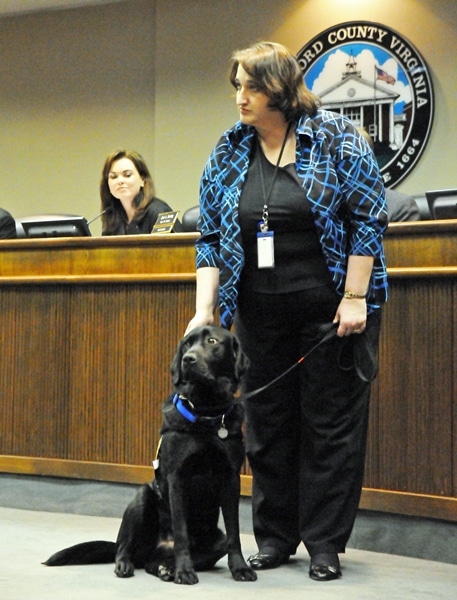
Stafford County Courthouse’s new dog, Kahn was introduced by his handler, Juanita Maley, to the county’s Board of Supervisors on Feb. 21. The dog will work with children and adult victims of sexual assault, domestic violence, elder abuse and other violent crimes. (Mary Davidson/PotomacLocal.com)

Victims of crimes in Stafford County will soon receive emotional support and comfort from a four-legged addition to the Commonwealth’s Attorney’s Victim-Witness Office. Kahn, a male black Labrador retriever, will join the Victim-Witness staff on Tuesday, February 21. The dog will work with children and adult victims of sexual assault, domestic violence, elder abuse and other violent crimes.

“Stafford’s court system has a deep respect and appreciation for the courage of the victims who come forward to work with our prosecutors,” said Chairman of the Board of Supervisors Susan Stimpson, Falmouth District. “Kahn will be a great help in making victims, especially children, more comfortable.”

Kahn will sit with victims and offer them comfort while they are being interviewed about what happened to them. Most victims, especially children, come into the office already traumatized. Having a dog there to pet relaxes people and helps them open up and give details to help bolster their case. The dog will not go into the courtroom but will be available for all aspects of pretrial preparation with victims.

“The goal of having a courthouse dog is two-fold,” said Commonwealth’s Attorney Eric Olsen, “We want the dog’s presence to make children and adults more comfortable so they can better tell their story. Plus, we hope it will help make a tough experience a little easier on those who’ve already had a hard time.”

After he was formally introduced to the Stafford County Board of Supervisors, Kahn (center dog) showed his playful side. Kahn and his handler, Juanita Maley, are part of the Victim Witness Assistance Program at the Stafford County Courthouse. (Mary Davidson/PotomacLocal.com)

Kahn and his handler, Juanita Maley of the Victim-Witness Assistance Office, recently completed training with the Courthouse Dog Program. The program trains handlers to work with dogs and victims in the criminal justice system. The dogs come from a group called Canine Companions for Independence, an organization that trains canine companions, service dogs and facility dogs like Kahn.

There was no cost for the dog. The training with the Courthouse Dog Program was $5,000 and was funded by assets forfeited by convicted criminals. The dog will work daily at the Courthouse and will live with its handler

Maley, who will provide for its upkeep. Canine Companions for Independence has a network of vets who provide services at reduced costs or for free for facility dogs.

-Press release


Warning from Doctors about tick season!

BOSTON (CBS) – They’re here. The mild winter temperatures we’re enjoying mean the danger from ticks and Lyme disease has arrived early. Normally at this time of year cold weather causes ticks to go dormant, but not this winter.

We went to a park in Needham Tuesday with entomologist Dr. Richard Pollack to see how easy it is to find the ticks. He dragged a small piece of fabric along the vegetation and after a couple of passes, there were deer ticks on the cloth.

WBZ-TV’s Jonathan Elias reports

“This unseasonable weather has extended the season for these ticks,” says Dr. Pollack. It’s a misconception that the first frost kills the ticks. “Normally the deer ticks are quiet. They’re hibernating at this time of year, but if it’s warm enough to be outside, it’s warm enough for the ticks to be active,” says Pollack. And that means a risk of Lyme disease at a time when you usually don’t have to worry about it. “The take home message really is if you’re out there enjoying the weather, take precautions. You may bring them home, your pets may bring them home,” says Pollack.

We met Norma Calder enjoying the lovely weather, walking her dog. She’s been on the lookout for ticks on her pet. “This winter I’ve probably found 10 or 12,” she says.

At Angell Animal Medical Center in Boston, they’re aware of the potential problems. “Whenever we do have warmer temperatures there is an uptick in the number of ticks we’ll see on dogs,” says Angell veterinarian Dr. Kiko Bracker.

A lot of dog owners take the winter off from applying tick preventative medications, but Dr. Bracker says that’s a bad idea this time. “This year it’s really best to use the tick repellants and tick preventatives twelve months a year, just to be safe,” he says.

The good news, this unusual tick activity now doesn’t mean there will be more of them in the Spring. In fact, if it stays dry some of them could die off because ticks don’t do well in dry weather. In either case, come Spring, we can also start worrying about mosquitoes.

Thursday, February 23, 2012

Ceaser Millian... A pack of Lies.....

OP-ED CONTRIBUTOR

Pack of Lies

Published: August 31, 2006

Miami Beach

Jeffrey Decoster

WITH a compelling personal story as the illegal immigrant made good because of his uncanny ability to understand dogs, Cesar Millan has taken the world of canine behavior — or rather misbehavior — by storm. He has the top-rated program, “Dog Whisperer,” on the National Geographic Channel, a best-selling book and a devoted following, and he has been the subject of several glowing magazine articles.

He is even preparing to release his own “Illusion” collar and leash set, named for his wife and designed to better allow people to walk their dogs the “Cesar way” — at close heel, under strict control.

Essentially, National Geographic and Cesar Millan have cleverly repackaged and promoted a simplistic view of the dog’s social structure and constructed around it a one-size-fits-all, cookie-cutter approach to dog training. In Mr. Millan’s world, dog behavioral problems result from a failure of the human to be the “pack leader,” to dominate the dog (a wolf by any other name) completely.

While Mr. Millan rejects hitting and yelling at dogs during training, his confrontational methods include physical and psychological intimidation, like finger jabs, choke collars, extended sessions on a treadmill and what is called flooding, or overwhelming the animal with the thing it fears. Compared with some training devices still in use — whips and cattle prods, for example — these are mild, but combined with a lack of positive reinforcement or rewards, they place Mr. Millan firmly in a long tradition of punitive dog trainers.

Mr. Millan brings his pastiche of animal behaviorism and pop psychology into millions of homes a week. He’s a charming, one-man wrecking ball directed at 40 years of progress in understanding and shaping dog behavior and in developing nonpunitive, reward-based training programs, which have led to seeing each dog as an individual, to understand what motivates it, what frightens it and what its talents and limitations are. Building on strengths and working around and through weaknesses, these trainers and specialists in animal behavior often work wonders with their dogs, but it takes time.

Mr. Millan supposedly delivers fast results. His mantra is “exercise, discipline, affection,” where discipline means “rules, boundaries, limitations.” Rewards are absent and praise scarce, presumably because they will upset the state of calm submission Mr. Millan wants in his dogs. Corrections abound as animals are forced to submit or face their fear, even if doing so panics them.

Mr. Millan builds his philosophy from a simplistic conception of the dog’s “natural” pack, controlled by a dominant alpha animal (usually male). In his scheme, that leader is the human, which leads to the conclusion that all behavior problems in dogs derive from the failure of the owner or owners to dominate. (Conveniently, by this logic, if Mr. Millan’s intervention doesn’t produce lasting results, it is the owner’s fault.)

Women are the worst offenders in his world. In one of the outtakes included in the four-DVD set of the first season of “Dog Whisperer,” Mr. Millan explains that a woman is “the only species that is wired different from the rest.” And a “woman always applies affection before discipline,” he says. “Man applies discipline then affection, so we’re more psychological than emotional. All animals follow dominant leaders; they don’t follow lovable leaders.”

Mr. Millan’s sexism is laughable; his ethology is outdated.

The notion of the “alpha pack leader” dominating all other pack members is derived from studies of captive packs of unrelated wolves and thus bears no relationship to the social structure of natural packs, according to L. David Mech, one of the world’s leading wolf experts. In the wild, the alpha wolves are merely the breeding pair, and the pack is generally comprised of their juvenile offspring and pups.

“The typical wolf pack,” Dr. Mech wrote in The Canadian Journal of Zoology in 1999, “is a family, with the adult parents guiding the activities of a group in a division-of-labor system.” In a natural wolf pack, “dominance contests with other wolves are rare, if they exist at all,” he writes.

That’s a far cry from the dominance model that Mr. Millan attributes to the innate need of dogs by way of wolves.

Unlike their wolf forebears, dogs exist in human society. They have been selectively bred for 15,000 or more years to live with people. Studies have shown that almost from birth they are attentive to people, and that most are eager to please, given proper instruction and encouragement.

But sometimes the relationship goes very wrong, and it is time to call on a professional.

Aggression is perhaps the most significant of the behavioral problems that may afflict more than 20 percent of the nation’s 65 million dogs, because it can lead to injury and death. Mr. Millan often treats aggression by forcing the dog to exercise extensively on a treadmill, by asserting his authority over the dog by rolling it on its back in the “alpha rollover,” and through other forms of intimidation, including exposure to his pack of dogs.

Forcefully rolling a big dog on its back was once recommended as a way to establish dominance, but it is now recognized as a good way to get bitten. People are advised not to try it. In fact, many animal behaviorists believe that in the long run meeting aggression with aggression breeds more aggression.

More important, aggression often has underlying medical causes that might not be readily apparent — hip dysplasia or some other hidden physical ailment that causes the dog to bite out of pain; hereditary forms of sudden rage that require a medical history and genealogy to diagnose; inadequate blood flow to the brain or a congenital brain malformation that produces aggression and can only be uncovered through a medical examination. Veterinary behaviorists, having found that many aggressive dogs suffer from low levels of serotonin, have had success in treating such dogs with fluoxetine (the drug better known as Prozac).

Properly treating aggression, phobias, anxiety and fears from the start can literally save time and money. Mr. Millan’s quick fix might make for good television and might even produce lasting results in some cases. But it flies in the face of what professional animal behaviorists — either trained and certified veterinarians or ethologists — have learned about normal and abnormal behavior in dogs.

Related Articles
Leading the Way offers doggie daycare and all types of training, including private, group classes and a residential training program. Behavior assessment and modification is done using ONLY positive methods focused on shaping behavior.

We have over 25 years of professional experience, dedicated to enhancing the relationship of both ends of the leash, through knowledge, compassion, and building long term relationships with our clients, both two and four legged.